
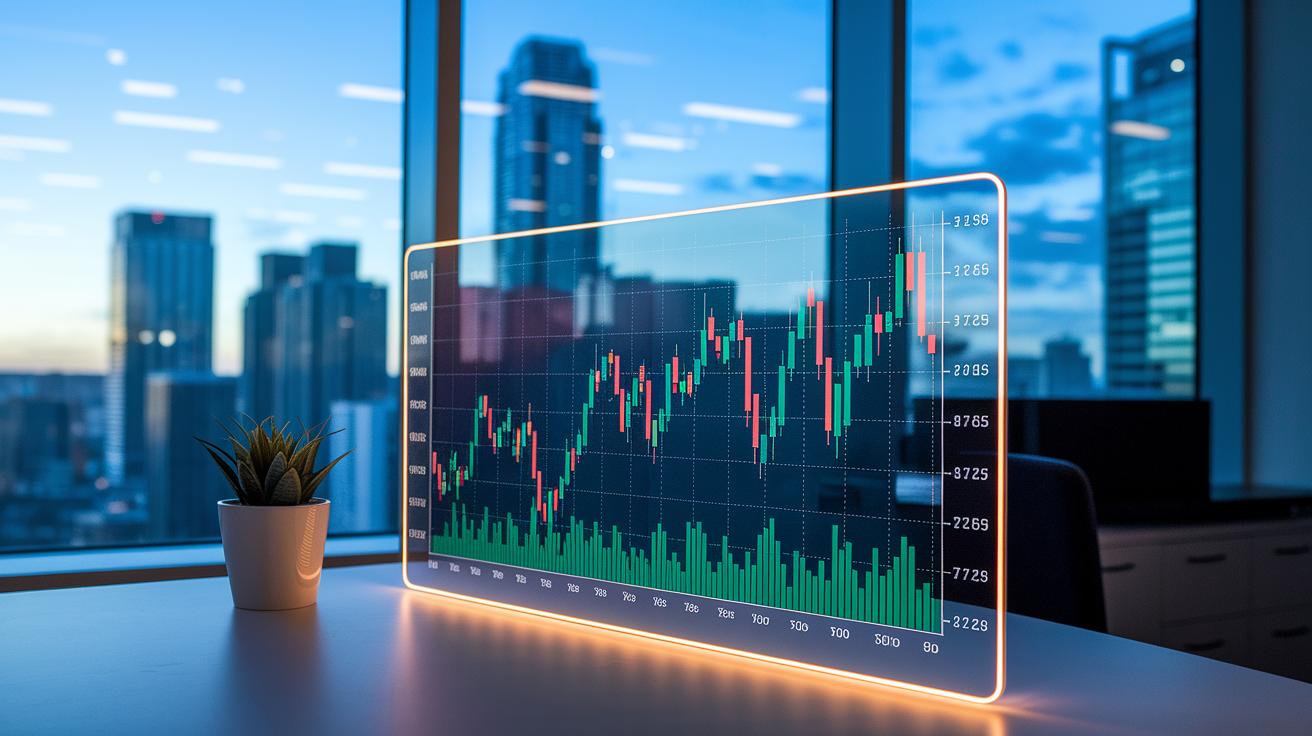
Have you ever thought that your trading moves might need a little guidance? A clear trading chart turns a jumble of numbers into an easy-to-read picture. Think of it like a map that shows you the best path when you trade stocks, forex, or crypto.
In this post, we break down how different charts work and how they can help you make smarter trading choices. Ready to see how these visual tools can make trading feel less risky and more rewarding?
How Trading Charts Provide Essential Market Insights
Trading charts are clear, organized pictures that turn complex data into something you can easily understand. They show information for things like stocks, forex, and even cryptocurrencies. This way, traders can quickly spot trends and decide when to buy or sell.
There are three main types of charts. First, line charts display only the closing prices, giving you a clean view without extra details. Next, bar charts show four key points, the open, high, low, and close, using a vertical line with ticks for the open and close. Finally, candlestick charts add a colored body to indicate if the price went up (green) or down (red) and use wicks to mark the highest and lowest points.
Choosing the right chart helps traders see what matters most. A line chart focuses on simplicity, while bar and candlestick charts offer more details for spotting changes quickly. For example, live price graphs on certain platforms let traders react fast and make smarter trading choices.
Comparing Trading Chart Types in Market Analysis

Line charts simply join closing prices so you can easily see the overall market trend. Bar charts offer more detail by showing the opening, high, low, and closing prices, which gives you a better idea of daily price changes. Candlestick charts, created in the 1700s by Munehisa Homma, use colored boxes and lines to spotlight market momentum and shifts in trends. For instance, the color cues in these charts can quickly tell you if the market feels strong or weak.
| Chart Type | Data Points | Visual Clarity |
|---|---|---|
| Line | Closing prices | High |
| Bar | Open, High, Low, Close | Medium |
| Candlestick | O, H, L, C plus body | High |
Choosing the right chart depends on the market conditions and what you want to learn. Use line charts for a smooth view of trends, bar charts if you're looking for a balanced picture of price moves, and candlestick charts if you need to spot detailed patterns, especially when used with technical analysis indicators, which help you understand how easily assets can be bought or sold.
Identifying Key Candlestick Patterns on Trading Charts
Doji
When you see a Doji, the opening and closing prices are nearly the same. This hints that buyers and sellers are in a stalemate, much like a brief pause in a heated conversation. It’s a quiet moment before the next big price move.
Hammer
The hammer shows up as a small candle body at the top with a long shadow below. It appears after a price decline, suggesting that sellers pushed prices down but buyers later stepped in to pull them back up. Think of it as a solid tap on the shoulder that might be signaling a change.
Shooting Star
The shooting star pops up in an uptrend with a small body and a long upper shadow. This tells us that even though prices reached high levels, buyers couldn’t hold on, and sellers may be gaining momentum. It often hints at a possible drop when the market confirms the shift.
Bullish Engulfing
A bullish engulfing pattern happens when a green candle completely covers a red candle. In simple terms, green means prices are rising and red means they’re falling. This clear takeover by buyers can feel like a green light in stop-and-go traffic, signaling a good time to consider buying.
Bearish Engulfing
On the flip side, a bearish engulfing pattern shows a red candle fully covering a prior green candle. This signals that sellers have taken charge, which might mean it’s time to review any bullish positions you have in a rising market.
Morning Star
The morning star is a three-candle pattern that starts with a downward move, followed by a small-bodied candle (sometimes a Doji), and finishes with a strong upward candle. This series of moves often indicates that buyer confidence is returning.
By blending these patterns with volume checks and other technical tools, you get a clearer idea of when to step in or out of a trade. It’s like piecing together clues that guide you to the best decisions.
trading chart: Crisp insights for smarter trades

Indicators are very useful for spotting market cues and guiding your trading moves. They provide extra clarity on price changes, so you can easily see trends and shifts. For example, trendlines mark key levels where prices may bounce, and moving averages smooth out the price data to show the overall trend. By pairing these with tools like RSI (which tells you if a market might be overbought or oversold on a scale from 0 to 100), MACD, and Bollinger Bands, you get a clearer picture of how the market behaves. It’s like adjusting the focus on a camera until your subject is clear.
| Indicator | Chart Placement | Signal Interpretation |
|---|---|---|
| Moving Average | Overlay on price | Shows trend direction |
| RSI | Below price pane | Indicates overbought or oversold conditions |
| MACD | Separate pane | Signals changes in momentum |
| Bollinger Bands | Overlay on price | Shows the range of volatility |
Mixing these indicator signals with chart patterns deepens market analysis. Watching how a moving average aligns with key support levels or how the MACD changes as a price pattern appears helps traders decide when to enter or exit a trade. When these signals match bigger market trends, they create a well-rounded strategy. This method confirms the strength of a trend and pinpoints cleaner entry and exit opportunities.
Advanced Charting Techniques and Time Frame Analysis
When you look at charts over different time frames, you can learn a lot about how the market behaves. Intraday charts capture quick, short-term changes. They’re great if you want to catch sudden trends. Daily charts offer a wider look at market moves, letting you see recurring patterns that might be missed in shorter time slices. With weekly charts, you smooth out the day-to-day ups and downs and get a clear view of the overall trend. Think of it like this: a noticeable dip on an intraday chart might not stand out at all when you zoom out to a full week, sort of like watching small ripples vanish in a large pond.
It also helps to adjust your scale settings and use custom templates. Switching between a linear scale, which shows numbers at equal steps, and a logarithmic scale, which highlights percentage changes, can give you a different perspective on price shifts. Many trading platforms let you save your favorite chart settings, from color schemes to alert options. Imagine having your preferred view ready each time, instantly highlighting important levels and patterns. This simple step can really change the game for your market analysis.
By combining these time frame techniques with the right scale settings, you build a solid trading plan. Experimenting with different charts and personalizing your view helps you spot trends earlier, making your decisions smarter and your analysis more precise.
Selecting and Using Trading Chart Platforms and Tools

When choosing a charting tool, keep it simple. Look for quality data, clear features, and good support for your device. You want a system that shows you neat, interactive price graphs and up-to-date charts right when you need them. Imagine tapping your tablet and getting a fresh, clear chart, like carrying a mini trading floor in your hand.
TradingView and MetaTrader each bring something special. TradingView offers both web and mobile options, with helpful drawing tools, community-created scripts, and visuals for testing strategies based on past data. MetaTrader focuses on testing automated strategies, lets you add your own indicators, and even lets you export data for further review. With free versions, you might only access basic charts, but a paid plan unlocks extra data and alerts to give your strategy a real boost.
It helps to try demo accounts and set up custom workspaces. Testing your ideas in demo mode means you can experiment without risking any money. Custom templates let you quickly spot key levels, and being able to download your data for offline review means you can study trends at your own pace. This practical approach allows you to refine your trading tactics without the stress of live trading.
Final Words
In the action, we explored how trading charts simplify market data and boost decision-making. We covered basic chart types, like line, bar, and candlestick, and looked at how each provides a clear picture of price movements. We also examined key candlestick signals, technical indicator overlays, and advanced tools that keep you set up for success. By combining these insights, you gain a stronger informed investment experience and build confidence in your market strategy. The future looks bright with clear data guiding every move.
FAQ
What do live trading charts and online trading charts show?
The live trading charts show up-to-date market data that traders can use to spot quick price changes and trends, enabling them to make timely decisions about buying or selling assets.
What are trading chart patterns and how do they help?
Trading chart patterns illustrate common price formations that signal possible future moves. They help traders spot key points for entering or exiting positions based on repeated market behavior.
Can I view trading charts as PDF files?
Trading chart PDFs offer a static, shareable snapshot of market data, allowing traders to analyze trends offline and keep a record of important price setups and market conditions.
What information does a trading chart for gold provide?
A trading chart for gold displays the price fluctuations and market trends specific to this commodity, helping traders understand its movements to make better-informed trading decisions.
Is there an app that offers trading charts?
A trading chart app delivers interactive, real-time market visuals on mobile devices, giving traders the convenience of tracking trends and accessing critical data on-the-go.
What is meant by a trading chart photo?
A trading chart photo is a captured image of market data at a specific moment, which can be shared or reviewed later to study historical trends and price action efficiently.
